In Cairns, the challenge often isn't just the bearing capacity—it's knowing how deep the weathered zone really goes. Many sites across the coastal plain sit on Wooroonooran metasediments or Barron River alluvium, where the transition from residual soil to weathered rock can be abrupt and unpredictable within a single lot. Standard drilling tends to smear that boundary, but a piezocone with continuous u₂ response picks up the change in drainage character immediately. We run a 20-tonne CPT rig that can push through stiff silty clays and loose sands without pre-drilling in most Trinity Park to Edmonton corridors, delivering a near-continuous qc, fs, and u₂ profile that lets us identify thin compressible lenses a standard SPT might miss entirely. For sites near the Mulgrave River floodplain, where the water table sits within 1.5 m of surface, we often pair the CPT with seismic refraction to tie dynamic properties to cone resistance before specifying footing levels.
A piezocone in Cairns clay doesn't just log strength—it captures the drainage state that governs how fast a footing will settle.
Service characteristics in Cairns
Typical technical challenges in Cairns
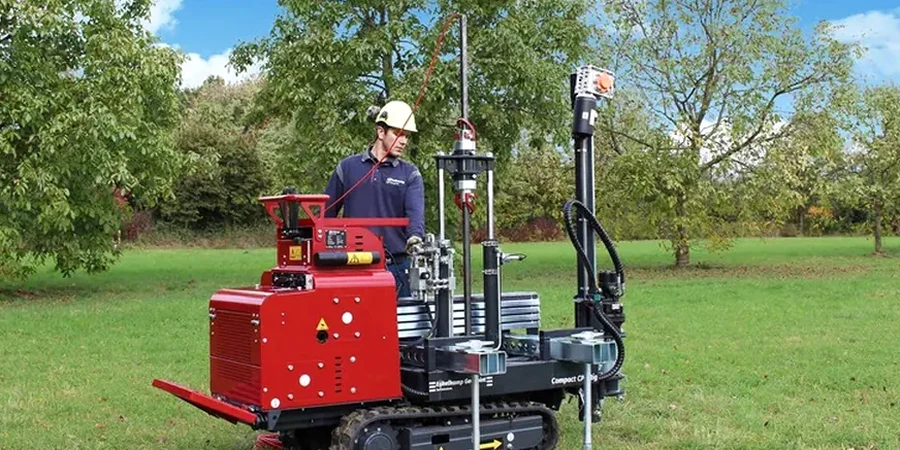
The rig we mobilise in Cairns is a 20-tonne truck-mounted CPT system with hydraulic stabilisers and an onboard data acquisition cabin—it's purpose-built for tropical conditions, with sealed electronics against humidity and an air-conditioned operator station that keeps the DAQ running without overheating even during a November buildup. The main risk we see in the field isn't equipment failure; it's pushing through a desiccated crust without recognising the soft layer beneath. In the dry season, the upper 2 m of clay in suburbs like Bentley Park can register qc values above 3 MPa, giving a false sense of stiffness. If the test stops at 5 m and doesn't penetrate the underlying soft marine clay, the foundation design ends up dangerously optimistic. We always run at least one dissipation test per soil unit to confirm drainage behaviour, and if the pore pressure ratio Bq stays above 0.6, we flag it as a compressible layer requiring staged loading or Improvement. On sites near the Cairns waterfront, where tidal fluctuations affect the phreatic surface within the cone hole, we backfill with bentonite grout after extraction to prevent cross-contamination between aquifers.
Our services
Our CPT program in the Cairns region is structured around the specific subsurface conditions found in the wet tropics—highly variable saprolite depth, soft estuarine clays, and shallow groundwater. Each service package includes the raw digital data, a processed log with SBT classification per Robertson (2016), and a factual report signed by the field operator and the reviewing geotechnical engineer.
Piezocone Profiling for Foundation Design
Continuous qc, fs, and u₂ log with dissipation tests at target depths. Delivers stratigraphy, undrained shear strength (Su), constrained modulus (M), and soil behaviour type (SBT) for shallow footing and pile design in Cairns alluvium.
Liquefaction Screening CPT
Targeted CPT soundings in saturated sandy layers of the Barron Delta, processed per Boulanger & Idriss (2014) to compute factor of safety against liquefaction. Includes fines content estimation from Ic and site-specific PGA from the Cairns seismic hazard model.
Settlement and Consolidation Analysis
Dissipation-based estimation of coefficient of consolidation (cv) in the Trinity Inlet estuarine clays. We combine multiple t₅₀ values with oedometer correlations to provide constrained modulus profiles for one-dimensional settlement calculations under embankment or slab loads.
Q&A
How much does a CPT test cost in Cairns?
For a single CPT sounding to 20 m depth in typical Cairns alluvium, the cost ranges from AU$270 to AU$360 per metre depending on access conditions and whether pore pressure dissipation tests are required at multiple depths. Mobilisation is quoted separately based on location within the Cairns region.
What depth can CPT reach in Cairns soils?
In the alluvial clays and sands of the Barron River plain, we typically reach 25–30 m before encountering gravel layers that cause refusal. In the residual soils derived from metasediments on the slopes west of the CBD, refusal can occur much shallower—sometimes at 8–12 m—when the cone hits boulders or highly cemented saprolite.
Does CPT replace SPT for foundation design in Cairns?
CPT provides a near-continuous profile of cone resistance and pore pressure, which gives much finer stratigraphic resolution than SPT at 1.5 m intervals. For most Cairns sites on soft clays or sands, CPT alone with a few dissipation tests is sufficient for shallow foundation design. However, when gravels or very stiff residual soils prevent full penetration, we complement the CPT with SPT drilling to reach design depth and obtain samples for laboratory testing.
How do you interpret CPT data for Cairns' tropical residual soils?
Tropical residual soils in Cairns—particularly those formed over the Barron River Metamorphics—often plot outside standard SBT charts because their fabric retains relict structure that affects friction ratio. We apply the Robertson (2016) normalised SBTn chart with local calibration from nearby boreholes, and cross-check with Atterberg limits from disturbed samples where the cone response is ambiguous. This ensures the soil behaviour type classification reflects the actual engineering behaviour rather than just the grain size distribution.