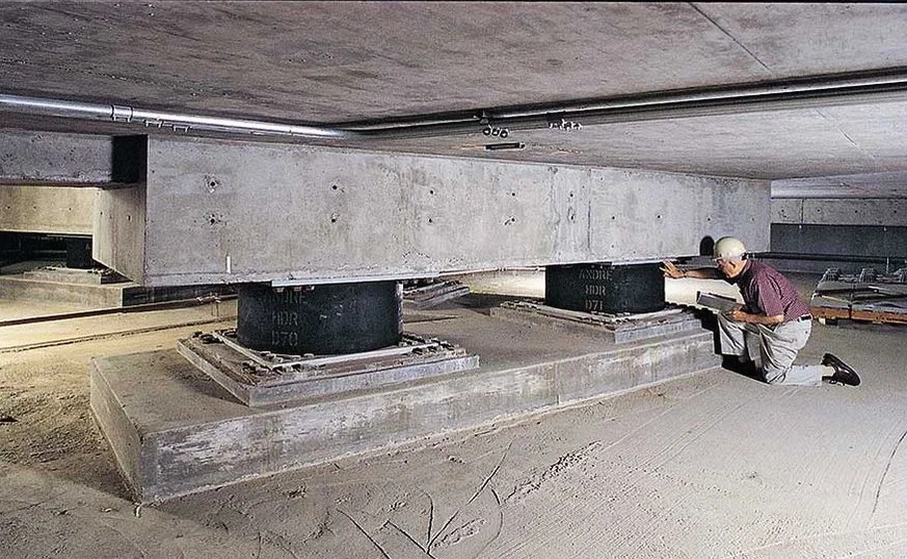
A waterfront apartment tower planned for the Esplanade might look serene, but the structural demands of Cairns are anything but calm. The city sits on varied ground—from the deep alluvial silts near the Barron River delta to the weathered metamorphic rock of the Whitfield Range—and carries a seismic hazard classification under AS/NZS 1170.4 that surprises many developers. Base isolation seismic design inserts a flexible layer between the foundation and the superstructure, dramatically reducing the forces transmitted during an earthquake. Our team provides a complete cycle, from NATA-accredited triaxial testing of the soil to the dynamic analysis required for isolator selection, ensuring the solution fits the specific ground conditions of Cairns' 170,000-strong community. Without this approach, a stiff structure on soft ground becomes an amplification machine, risking extensive damage even in a moderate event.
In Cairns, base isolation doesn't just reduce seismic drift—it breaks the chain between ground movement and structural damage, cutting peak floor accelerations by up to 70%.
Service characteristics in Cairns
Typical technical challenges in Cairns
A common oversight in tropical Queensland is focusing exclusively on wind loads and treating seismic design as an afterthought. In multi-storey masonry or concrete shear-wall buildings common in the CBD, a fixed-base design can attract seismic forces significantly higher than the wind demand on the lateral system. The real danger manifests at the soil-structure interface: soft clay layers can magnify the ground motion, a phenomenon we consistently observe in borehole data from the Portsmith industrial area. Base isolation seismic design directly addresses this by lengthening the structure's fundamental period, shifting it away from the dominant energy content of the earthquake. Ignoring this step risks brittle failure in non-ductile elements, particularly in older structures being assessed for change-of-use or vertical extensions under the Queensland Development Code.
Our services
Our Cairns-based analysis integrates geotechnical reality with structural dynamics. We don't just select an isolator from a catalogue—we run full 3D nonlinear models validated by site-specific ground investigations.
Nonlinear Time History Analysis & Isolator Specification
We build a detailed structural model incorporating the hysteretic properties of the proposed isolation system. Using spectrum-compatible ground motions for the Cairns region, we verify inter-story drift, residual displacement at the isolation plane, and uplift potential. The output is a performance-based specification ready for council submission.
Site-Specific Seismic Hazard Assessment
Before any bearing is sized, we conduct a probabilistic seismic hazard analysis (PSHA) for the site coordinates. This defines the uniform hazard spectra and deaggregation for both 500-year and 2500-year return periods, feeding directly into the isolator design displacement per AS/NZS 1170.4 Section 12.
Q&A
What is the typical cost range for a base isolation seismic design package for a medium-rise building in Cairns?
For a typical mid-rise structure in the Cairns area, the complete design package—including site hazard assessment, nonlinear time history analysis, isolator specification, and peer review documentation—falls between AU$6,600 and AU$13,720. The final figure depends on the structural irregularity, the number of ground motion sets required, and the complexity of the prototype testing protocol.
Is base isolation mandatory for buildings in Cairns under the National Construction Code?
Base isolation is not a prescriptive requirement for most buildings in Cairns. However, for structures classified as Importance Level 3 or 4 (such as hospitals, emergency facilities, or large public venues), AS/NZS 1170.4 imposes stricter drift limits and performance criteria. In these cases, a conventional fixed-base design often becomes structurally inefficient, making base isolation the most cost-effective path to compliance.
How does the high water table near the Cairns waterfront affect base isolation design?
A high water table, common in suburbs like Machans Beach and the central Esplanade precinct, requires careful detailing of the isolation pit or moat. The design must include waterproofing of the seismic gap and a drainage system capable of handling storm surge and king tide events. Structurally, the presence of water-saturated silts demands a rigorous assessment of bearing capacity under the isolators' pedestals to prevent differential settlement during a seismic event.
Can base isolation be retrofitted to an existing heritage building in Cairns city?
Yes, retrofitting is technically feasible and has been successfully applied to masonry heritage structures. The process involves temporarily supporting the building on jack piles, cutting the columns or walls at the isolation plane, and installing the bearings. In Cairns, the main challenge is the soft soil profile, which requires a stiff transfer structure at the foundation level to ensure all isolators displace uniformly. A detailed condition assessment of the existing footings via test pits is the essential first step.