In Cairns, where the soil profile shifts from decomposed granite foot slopes to deep alluvial clays across the floodplain, a standard penetration test tells only part of the story. The triaxial test provides the effective stress parameters that control how a foundation behaves under sustained loading and high pore-water pressure. The city’s average annual rainfall exceeds 2,000 mm, and the water table in suburbs like Portsmith or Earlville can sit within a metre of the surface for months at a time. That persistent saturation changes everything: a clay that looks stiff in a hand sample can lose more than half its strength when sheared under undrained conditions. Our laboratory runs triaxial programs on undisturbed Shelby-tube samples recovered from project sites across the Cairns region, applying back-pressure saturation to replicate the in-situ moisture regime before shearing. For deep basement excavations near the Esplanade, where the marine clay layer reaches thicknesses of 8 to 12 metres, the consolidated-undrained test with pore-pressure measurement is the only reliable way to determine the undrained shear strength for temporary works design. Engineers who combine this data with a CPT test can cross-validate the strength profile and refine the soil model before committing to a retention system.
In Cairns’ saturated residual soils, the effective friction angle from a drained triaxial test is often the single most influential parameter in a basement retention design - and the one most penalised by generic assumptions.
Service characteristics in Cairns
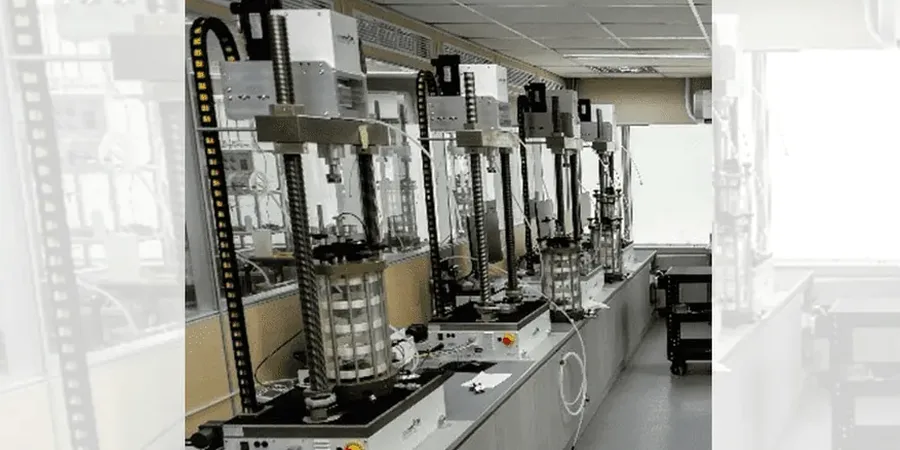
Field demonstration
Typical technical challenges in Cairns
A three-level apartment excavation in Bungalow ran into trouble when the geotechnical report relied on SPT N-values correlated to undrained shear strength via a generic clay formula. The contractor opened the cut and within 48 hours the base heaved 150 mm, cracking the shotcrete facing on the southern wall. The problem was not the N-value but the assumption that the marine clay was normally consolidated. Subsequent triaxial CU tests on piston samples from the same depth revealed an overconsolidation ratio of 1.8 and an undrained strength ratio Su/σ’v of 0.28 - significantly lower than the 0.35 assumed in the original design. The retaining wall had to be propped and the basement slab poured in smaller panels. In Cairns, where the geology transitions from residual soil to estuarine sediment within the footprint of a single building, skipping a triaxial program can turn a straightforward excavation into a remedial works claim. The test is not an academic exercise: it is the difference between a retention system that holds and one that requires mid-construction redesign.
Our services
The triaxial test is rarely ordered in isolation. In Cairns, most geotechnical investigations pair it with index testing and field exploration to build a complete stress-strain picture.
Consolidated-Undrained (CU) Triaxial with Pore Pressure
Three-stage saturation, consolidation, and shearing under controlled back-pressure. We measure excess pore pressure at the mid-height of the specimen throughout the test, allowing separation of total and effective stress paths. This is the standard test for soft to firm clays encountered in Cairns basement excavations, delivering undrained shear strength and effective stress friction angles from a single specimen set.
Consolidated-Drained (CD) Triaxial
Slow-strain shearing with full drainage permitted throughout the test. We use this protocol for residual soils and weathered rock from the Cairns hinterland where long-term drained conditions govern design. The test provides the effective friction angle and the critical state friction angle for use in finite element and limit-equilibrium slope models.
Q&A
When should a triaxial test be specified instead of a direct shear test for a Cairns site?
Triaxial testing is preferred when the load path involves undrained loading (such as rapid excavation or embankment construction on saturated clay), when pore-water pressure measurement is required to separate effective and total stresses, or when the failure plane is not forced to be horizontal. In Cairns, this typically applies to basement excavations in the marine clay layer, foundation design for structures on the Barron River floodplain, and slope stability analyses where the critical failure surface is curved.
How long does a triaxial test program take from sample collection to report delivery?
A standard CU triaxial program on three specimens, including saturation, consolidation, and shearing, typically requires 10 to 14 working days. This extends to 15 to 18 days if drained (CD) tests are requested, due to the slower strain rate needed to maintain drained conditions throughout shearing.
What does triaxial testing cost for a typical Cairns project?
A triaxial test program on three undisturbed specimens, including saturation, consolidation, shearing, and a report with stress paths and Mohr-Coulomb parameters, generally ranges from AU$2,810 to AU$3,880. The final cost depends on whether CU or CD protocols are used, the number of confining pressures, and the consolidation stage requirements.