Cairns has grown from a remote port servicing the Hodgkinson goldfield in the 1870s into a modern tropical city wedged between the Coral Sea and the Great Dividing Range. This geography means developable land often sits on ancient alluvial fans or steeply weathered metamorphic slopes where level building platforms come at a cost. Retaining wall design here is not a catalogue exercise; the combination of deeply weathered Barron River metamorphics, high seasonal groundwater perched on saprolite, and cyclonic rainfall intensities exceeding 200 millimetres in 24 hours demands solutions rooted in local geotechnical observation. Many hillside subdivisions in suburbs like Whitfield and Edge Hill were carved into these residual soil profiles decades ago, and their ageing masonry walls are now being replaced with engineered structures that account for modern loading codes and today’s understanding of unsaturated soil mechanics. The team has consolidated experience across hundreds of residential and commercial retaining wall design projects in Far North Queensland, bringing laboratory data and field investigation together under the framework of [AS 4678](/) and the relevant parts of the National Construction Code.
A well-designed retaining wall in Cairns manages 2.5 metres of seasonal groundwater fluctuation before it manages the soil wedge behind it.
Service characteristics in Cairns
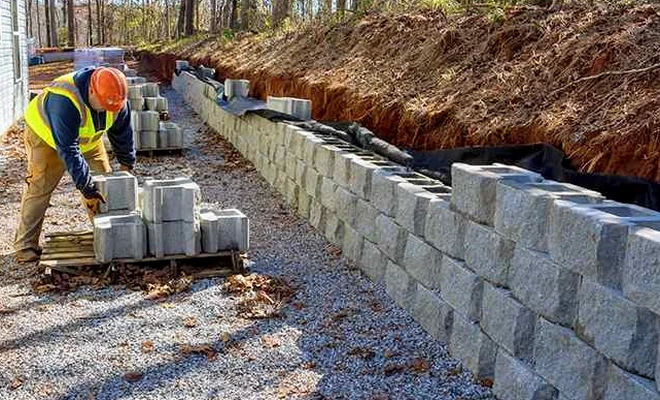
Typical technical challenges in Cairns
Many builders in Cairns underestimate how quickly a saturated residual clay profile transitions from stiff to soft when drainage is blocked. We see this repeatedly in older retaining wall design failures along the slopes above Trinity Inlet: a single unmaintained gravel drain behind a block wall, a few days of monsoonal trough rainfall, and the wall rotates forward by 40 to 80 millimetres, cracking the panel joints. The financial consequence of rebuilding a failed wall often exceeds $25,000 for a typical suburban block, not counting the cost of temporary shoring while the hillside is re-excavated. Another local risk is uncontrolled fill placement. In suburbs built on former sugar-cane paddocks, such as parts of Gordonvale, undocumented fill layers containing decomposing organic material can settle differentially and impose surcharge patterns that were never in the original retaining wall design. A site-specific investigation that identifies these layers before the wall alignment is fixed is the cheapest insurance a developer can buy.
Our services
Retaining wall design in Cairns spans simple gravity solutions for garden terraces to fully instrumented anchored systems securing arterial road corridors. The four service packages below reflect the range we deliver under a single engineering responsibility.
Gravity and Cantilever Wall Design
Reinforced concrete cantilever, masonry block, and mass-gravity walls up to 3 metres retained height. Includes bearing capacity checks on residual clays, global stability analysis, and detailed drainage specifications for cyclonic rainfall conditions.
Bored Pile and Contiguous Pile Walls
Design of piled retaining wall design solutions for tight boundaries in suburbs like Cairns North and Parramatta Park. Pile diameters typically 450 to 900 millimetres, socketed into fresh rock below the weathered zone, with shotcrete infill panels.
Anchored and Soil-Nailed Systems
Permanent and temporary anchored walls for deep excavations near existing structures. Corrosion-protected strand anchors proof-tested to 1.25 times working load, designed for aggressive tropical soils with resistivity below 2,000 ohm-cm.
Reinforced Soil and MSE Walls
Mechanically stabilised earth walls using geogrid reinforcement and segmental block facings. Particularly suited to approach ramps and bridge abutments on the Bruce Highway corridor where settlement tolerance is limited.
Q&A
What is the typical cost range for retaining wall design and documentation in Cairns?
For a single residential wall with retained height under 1.8 metres, engineering design and Form 15 certification generally falls between AU$1,520 and AU$3,200. Larger commercial or piled retaining wall design packages, including full geotechnical investigation and shoring design for excavations over 4 metres, typically range from AU$4,200 to AU$6,650 depending on complexity and number of design iterations required by Council.
Does Cairns Regional Council require a building permit for retaining walls?
Yes. Under the Cairns Regional Council Planning Scheme, any retaining wall exceeding 1.0 metre in height generally requires building approval, and walls over 2.0 metres trigger referral to a registered professional engineer for both structural and geotechnical certification. Walls on or near a property boundary must also comply with the Queensland Development Code MP 1.4 for siting variations.
How do cyclonic wind loads affect retaining wall design?
Cyclonic wind loads do not act directly on the soil mass behind a retaining wall, but the intense rainfall associated with cyclones and monsoonal lows in Region C generates transient perched water tables that can multiply lateral earth pressures by 30 to 50 percent. Our retaining wall design methodology for Cairns explicitly models fully saturated backfill conditions unless a verified drainage system with redundancy is provided.
What site investigation is needed before designing a retaining wall in Cairns?
At minimum, a site investigation to AS 1726 should include boreholes or test pits extending to a depth of at least twice the retained height below the wall base, with SPT N-values logged every 1.5 metres. In the Cairns context, laboratory testing for Atterberg limits, particle size distribution, and drained shear strength is strongly recommended because the residual soils derived from Barron River metamorphics can lose significant strength when remoulded or saturated. More info.