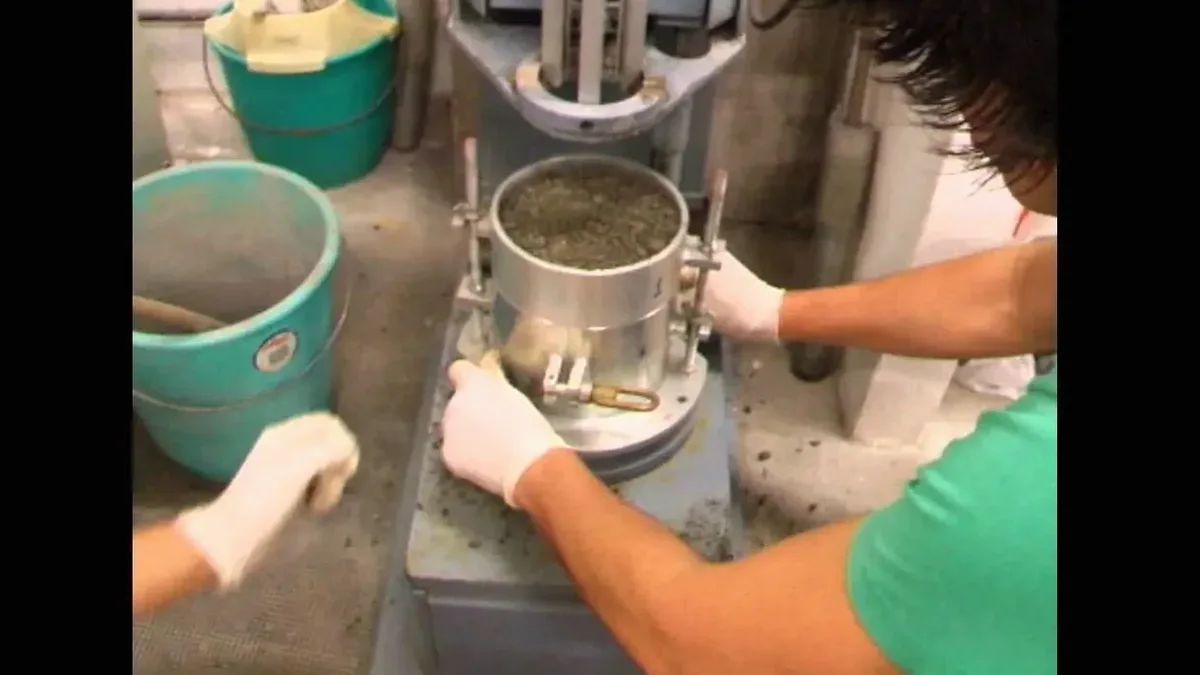
Cairns sits on a coastal plain where the geology shifts from decomposed granite in the foothills to deep alluvial clays and estuarine muds near the Barron River delta. These soils are often saturated for months each wet season, which makes compaction control one of the most critical steps before any slab pour, road base or retaining wall backfill. The Proctor test – both Standard and Modified, run to AS 1289.5.1.1 and AS 1289.5.2.1 – defines the maximum dry density and optimum moisture content for the exact fill material being placed on site. In a place like Cairns, where rainfall can exceed 2000 mm annually and seasonal groundwater rises to within a metre of the surface in suburbs like Portsmith and Manunda, a generic moisture-density curve from a textbook is worthless. The sand cone density test performed alongside the Proctor gives the field density ratio, and the Atterberg limits help predict how the same fill will behave once the monsoons arrive. Every compaction curve is run on material sampled directly from the borrow pit or cut area, not from a database, so the specification is tied to the real soil the contractor is working with.
In tropical Cairns, a Proctor curve built on dry-season material won't hold through February – the test has to match the moisture condition the fill will actually see.
Service characteristics in Cairns
Typical technical challenges in Cairns
The soil profile changes dramatically between a site in Earlville on the lower slopes of Mount Sheridan and a site in Yorkeys Knob on the coastal sand plain. In Earlville, residual silty clays with some gravel can hit 100% Standard Proctor density with a smooth-drum roller and careful moisture conditioning. In Yorkeys Knob, the same effort on loose beach sands produces a curve that looks flat and almost useless – the material needs a Modified Proctor reference and often a vibratory padfoot roller to lock the grains. The risk of using the wrong Proctor method is not theoretical. A Standard Proctor curve applied to a heavily trafficked industrial pavement in the Cairns Port area underpredicts the density achievable under modern compaction plant, leading to a spec that is too easy to pass but leaves the subgrade vulnerable to rutting under container loads. Conversely, specifying Modified Proctor on a wet, low-strength clay in a residential subdivision in Redlynch can force the contractor to over-roll and remould the soil, destroying its structure. The right test, tied to the right roller and the right layer thickness, is what keeps the lot acceptance rate high and the rework cost low.
Our services
The Proctor test alone gives the target numbers, but in the field the contractor needs a full control loop – from sampling to compaction verification. The following two services are the most common add-ons requested on Cairns earthworks projects and are handled by the same NATA-accredited team.
Field Density by Sand Cone (AS 1289.5.3.1)
Field density testing on the compacted layer to determine the relative compaction as a percentage of the Proctor maximum. Performed on subgrades, pipe bedding, road base and structural fill, with immediate pass/fail feedback to the roller operator and a formal NATA-endorsed report for the superintendent.
Moisture-Density Relationship for Borrow Material
Proctor curves run on multiple borrow sources to select the most cost-effective fill for a given project. Includes Atterberg limits and particle size distribution so the contractor can predict compaction behaviour, layer thickness and roller type before moving a cubic metre of material.
Q&A
What does a Proctor test cost in Cairns and what affects the price?
A Standard Proctor compaction test typically falls in the range of AU$180 – AU$240, while a Modified Proctor runs AU$280 – AU$360, depending on the number of moisture points required and whether oversize correction is needed. The main cost drivers are the material type – coarse gravels take longer to prepare than fine clays – and the urgency of the report. Volume discounts usually apply when multiple Proctor curves are commissioned alongside field density testing on the same contract.
When should I use Modified Proctor instead of Standard Proctor?
Modified Proctor is specified when the pavement or fill will carry heavy, repetitive loading – think highway embankments, container hardstands, airport aprons or deep structural fills under multi-storey buildings. Standard Proctor is still common for residential slabs, landscaping fills and low-rise commercial pads. The decision ultimately rests on the project specification, but as a rule of thumb, if a Main Roads or TfNSW standard applies in the Cairns region, it will almost always require Modified Proctor on the sub-base and basecourse layers.
How long does the lab need to produce a Proctor curve?
A Standard Proctor curve is usually reported within 24 to 48 hours after the sample arrives at the lab, provided the material does not require extended drying. Modified Proctor takes 48 to 72 hours because of the extra compactive effort and the larger number of moisture points. For critical earthworks where the roller is waiting, we can run an accelerated schedule and phone the optimum moisture content and maximum dry density ahead of the formal report.
Can the Proctor test be done on material with gravel and stones?
Yes – AS 1289.5.4.2 provides a method for correcting the Proctor curve when oversize particles are present. Material retained on the 37.5 mm sieve is removed, and a correction is applied to the measured density based on the percentage and specific gravity of the oversize fraction. For fills with a significant cobble content, the 6-inch mould is used to reduce the correction magnitude and give a more representative result for the matrix material.