Cairns sits on a narrow coastal plain wedged between the Coral Sea and the Great Dividing Range. The subsurface here is rarely uniform. Deep alluvial clays from the Barron River delta mix with colluvial debris and highly weathered Hodgkinson Formation metamorphics. When a structural engineer requests a site class under AS 1170.4, a standard borehole log won't cut it. You need a direct measurement of shear wave velocity. That's where the Multi-channel Analysis of Surface Waves comes in. The MASW method delivers a continuous Vs profile down to 30 metres without drilling disturbance. On sites near the Esplanade mudflats, we've recorded Vs30 values well below 180 m/s, which pushes the seismic design category into Class D or E territory and changes foundation economics. For deeper verification in variable ground, CPT testing provides continuous tip resistance data that correlates well with low-strain stiffness, and seismic refraction can map bedrock depth across the full footprint before finalising the site class.
A measured Vs30 under 150 m/s in Cairns means the difference between a standard footing and a raft with Improvement. We get you that number in three days.
Service characteristics in Cairns
Typical technical challenges in Cairns
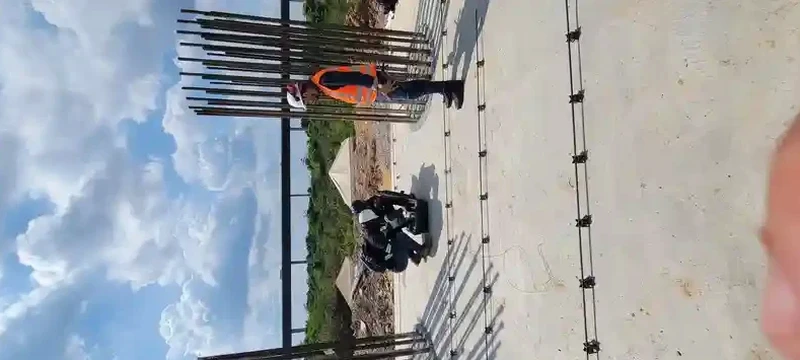
The geophone spread runs 46 or 92 metres across the ground, crossing whatever surface conditions the site presents. On a vacant lot in Mooroobool, that might mean long grass and buried builder's spoil. On a sugar cane paddock near Gordonvale, the crew works between rows and watches for irrigation pipes. The sledgehammer swing is the critical moment. A weak strike on soft ground fails to generate enough low-frequency energy and the dispersion curve truncates above 15 Hz, leaving the deep velocity unresolved. The crew leader checks each shot record on a field laptop before moving the spread. If the fundamental mode is weak, we add a heavier source or stack more shots. The field setup takes 30 minutes. The rest is walking the line and swinging the hammer. A standard shoot runs quiet, but near the Cairns airport flight path we note the noise spikes from turboprop take-offs in the QA log.
Our services
The MASW survey in Cairns is typically part of a broader site characterisation package. These are the services most often paired with a Vs30 measurement.
Vs30 Site Classification
Single-line or orthogonal MASW survey to determine AS 1170.4 site class. Includes dispersion analysis, inversion, and Vs30 calculation with uncertainty bounds.
Combined MASW + Seismic Refraction
Joint survey using the same spread to deliver Vs30 plus a P-wave bedrock profile. Useful where depth to rock varies sharply across the pad.
Downhole Seismic (Cross-Check)
Borehole-based Vs measurement with downhole triaxial geophone. Used to calibrate MASW results when near-surface velocity inversions are suspected.
Q&A
How much does a MASW survey cost in Cairns?
The fee for a standard MASW Vs30 survey in Cairns runs between AU$2,370 and AU$4,740, depending on the number of lines, site access, and whether the scope includes a combined refraction survey. A single 46-metre line with a 24-channel spread sits at the lower end. Two orthogonal lines or a 92-metre spread with additional processing push toward the upper end. The price covers field work, inversion, report, and the signed AS 1170.4 site class letter.
What site class does AS 1170.4 require MASW for?
AS 1170.4 assigns site classes B through E based on Vs30. Class B requires Vs30 > 360 m/s, Class C is 180–360 m/s, Class D is 150–180 m/s, and Class E is under 150 m/s. MASW provides the direct Vs30 measurement needed to place the site in the correct class. Indirect methods like SPT blow-count correlation are permitted by the standard but carry higher uncertainty, which can lead to an over-conservative or unconservative design.
Can MASW work on a sloping site in Cairns?
Yes, with adjustments. The standard inversion assumes a 1D layered half-space, so a steep slope violates that assumption. On sloping ground we set the spread along the contour rather than up the fall line. If a cross-slope measurement is required, we use a shorter spread and check the dispersion curve for mode contamination. For sites with more than 15 degrees of slope, we recommend a downhole seismic test as a cross-check.
How long until I get the Vs30 result?
A draft Vs30 number is available within 24 hours of the field work. The full report, including the dispersion image, inverted profile, and commentary on data quality, takes three working days. For urgent foundation redesign we can turn the final report in 48 hours by arrangement.